A note to new readers: an asemic horizon text is typically fractioned in numbered sections; each does depend on the previous ones, but I encourage you to skip to the next section if you find yourself bored or unsure of the relevance of what you’re reading. You can always circle back; in truth, everything here also depends on everything ever written for asemic horizon, and that certainly can’t be absorbed in one sitting.
I.
Notwithstanding Laruelle’s verve, Meillassoux’s vertigo or Zizek’s relevance, I don’t think there’s a real candidate for the living philosopher of note — the deepest, most fascinating and most polemical — other than Jean-Yves Girard. I don’t think he knows he’s even in the running.
Jean-Yves Girard is, after all, the outstanding logician of the 20th century, having laid waste on stagnating trends of his field with technical virtuosity and dry humor. Moreover, while his magnum opera is only now penetrating the computing mainstreams (e.g. with linear types; think Rust), but the kinds of logical theories he foregrounded are by now the basis of even the manager-safest, x-sharp corporate technologies. Not, of course, that the goal of logic is to provide foundations for computer science — how that has even happened?
Girard does realize he has become a philosopher in the 21st century, but I don’t know that he understands that philosophers can be important, let alone that he’s a very important one. In private correspondence with me, he’s been very dismissive of Deleuze (who he has probably bumped into many times in places like the post office — how does one city even accommodate two men of such stature at the same time?), whom he tasks with having taken Lewis Carroll’s tortoise tale at face value, failing to produce the Girardian critique independently.
A bumbling fool’s motivation for you to seek him out is that he becomes a philosopher because there’s a nausea inherent to logic, somewhat comparable to the nausea others have found in language, knowledge, freedom or time. Girard can’t fault others, however intellectually ambitious, for not being master logicians like him, but it’d be natural if he expected men of deep reflection to notice the nausea. Because he’s deeply original, this nausea is unlike anything you might conjure out of mere speculation. There’s a good book called “The Phantom of Transparency”, but nothing can beat this video (https://www.youtube.com/watch?v=Nc3pgZxU-Cg) as an introduction — not only because it’s short, but also because it’s breathless and kaleidoscopic. I think Jean-Yves Girard might even have developed this style of performance to try and communicate the nausea. I thoroughly recommend watching it attentively — even if you don’t understand one “euh” of French.
II.
The title of the Second Epideictics comes from a quotation (actually, a slide title; might as well be an aside said while sneezing; inserting his deeper thoughts here would overwhelm me and this project) by Jean Yves Girard: true theorems have corollaries. In professional mathematics, “theorem” is an informal badge of relevance; lesser proven statements are “lemmas” if ancillary to proving theorem, or “corollaries” if incidental consequences. This taxonomy privileges the clarity of exposition (math is hard, a hundred million souls cry in unison), which is not the same as foresight: from Ito to Yoneda, many results labeled as lemmas belong to the highest accomplishments of maths (which is to say, of Man, the hominins, nature itself, God). What was a pivotal intermediate point towards a theorem turns out, in time, to have many corollaries. A great lemma is a miniature mathematical theory.
(Consider, for a counter-example, the justifiably true statement that two orthogonal — in the Euclidean sense — 3-vectors named u, v have an inner product <u,v> zero. While useful, this is not a true theorem; you can probably use it to prove that the same is true for 4-vectors, but this follows in arbitrary dimensions from the axioms that define an inner product — therefore without induction through the particular cases).
III.
I set out today to write an essay on the “pick-up arts” — the various methods and underlying theories whose goal is to increase your body count. (Given a basis of bases — first base is kissing, etc. — you actually have a body count vector. This is math abuse humor to help us transition). Why did you read ~700 words on obscure philosophers and mathematical style instead? Because there’s theory to be found in certain bits and pieces of “the game”, as there’s theory to be found in Jamie Hamilton’s writings on soccer or the various Indian and Buddhist books of dharma.
Needless to say, what follows is mostly from the perspective of straight men; same-sex attraction is much less complicated, and women’s version of cherchez la femme is much less performative.
I’ve been fascinated lately by “daygame” content. The short vertical-form videos present either talented actors reading very well-written scripts, or unbelievable daredevil stunts, at once cringe-inducing and heartbeat skip-causing. It’s a simple formula: an attractive young woman is existing in the world with arbitrary purpose, minding her own business; a man then walks up to her and starts talking to her. The payoff — the money shot, so to speak — is that she doesn’t shame him. Who, however attractive himself, even takes the risk?
The real reason why there are two sexes/genders is that, out there in reality, there are two groups generically able to shame each other as easily as they breathe. (Plainly put, men are always-on; a woman’s best defense against the constant drone of male thirst is shaming. Don’t shaming-shame women!) But men not engaged in daygame tend either to attempt “the approach” when already buoyed by risk-attenuating signals of interest; or they find themselves in situations with enough momentum that neither man or woman feel an “approach” coming (this is greatly recommended). The way of General Axiology is to convert the first case into the second; enough exposure to theory will enable you to see that “the approach” is really effected by the interfacticity.
The shame, of course, is very real, and asemic horizon‘s general approach to seduction (dress normal; open up space for misinterpretation; don’t be yourself, just be) has little to say about it, for our basic conceit is to suspend kairos whenever convenient. Daygame, on the other hand, foregrounds the shame; it really consists of an array of technical devices for evading the shame while attempting to build momentum. These technical devices are mostly derived from pure speculation and misogynistic prejudices, but there’s a structure to them that uses strong theoretical elements; a lot of tempo management, a strong emphasis on chroma shifting (“yes, what I’m going to say is cheesy, cheesy is good”) and, of course, puncturing the diegesis. This last point is where the first of two intelligent aspects of daygame come out: the crucible of the approach is like the buddhist master’s wooden raft that’s meant to be used to cross the river and then left behind; the heart sutra of day game goes: make plans for a date; concrete plans with a time and a date and a place. That’s much harder than coaxing a phone number, but really — interrupting a woman’s day just to get her number (or even to get her to laugh at your jokes for the self-esteem boost) is plain harassment.
IV.
Need I stress that I don’t support people getting into daygame at this point? As seen in videos, daygame is a virtuoso performance. But the more you’re unable to let the interfacticity handle the heavy lifting, the more you’ll be interested in the explicit methodologies, the tips and tricks that really contain nothing of the daygamer’s artistry — and also the more you’ll just sound and look and smell like a creep. You shouldn’t really seek out opportunities, but rather just exist, dangerously and ambiguously. If you came here somehow googling PUA words and must have something actionable: go out at night where people are buzzed; talk to people with the goal of shaking their hands; get a little buzzed; if there’s music you can use it and feel free to dance. Tell everyone you meet a different name. Don’t be yourself, just be.
V.
The second interesting aspect to daygame is what their jargon file call kino. Puncturing the diegesis is a pure chrema move; developing the momentum for that involves a lot of chroma footwork. Now: kino (physical touch during the approach; preferably from her brushing your arm) builds momentum for the finale, but is also a partial reward, which competes with the finale (setting up an actual date). Kino, is after all, just the more electrical, tactile components of whatever in her reaction, unintentional or not, that pleases him; genuine warm smiles and so on — all noncommittal gestures that fail to make the “ladder-theoretical” leap that’s the whole point of PUA.
I think we need this diagram again:
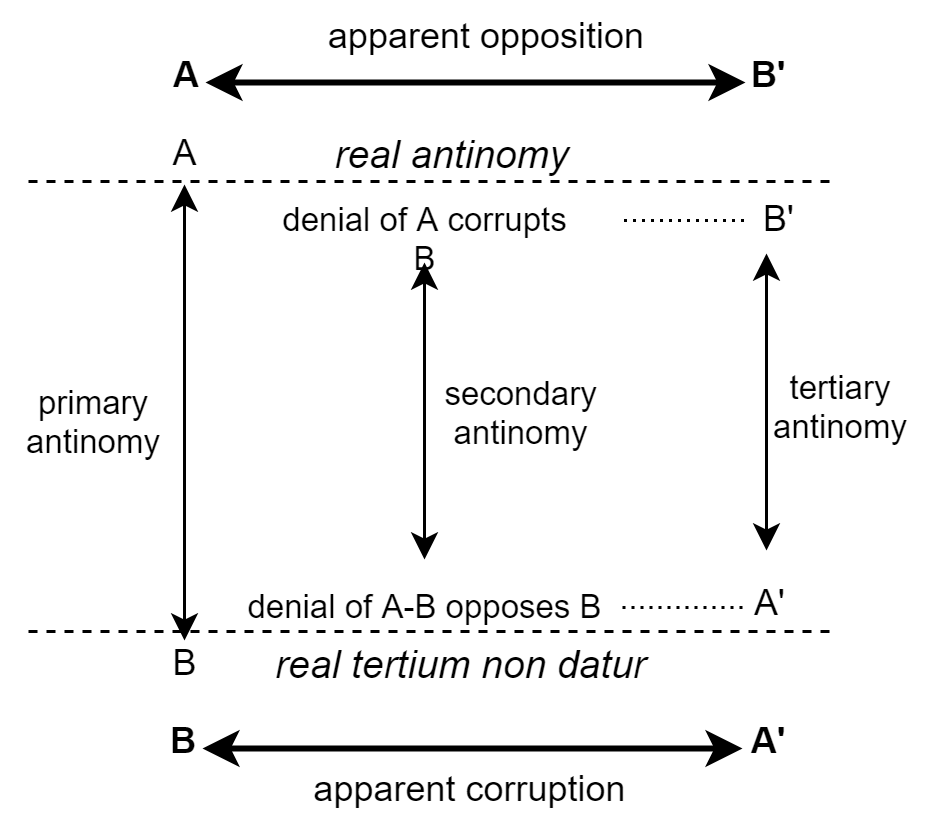
Here, A is the puncturing of the diegesis (making plans for an actual date with a time and place, dissolving “the approach”), while B is kino. This primary antinomy induces a second one. On the one hand, denying the finale corrupts kino, making it creepy touchy harassment. On the other, the denial of the primary antinomy (the terms are either fused or unrelated) opposes kino-as partial-reward entirely.
These two poles are represented in the top and bottom horizontal lines of the diagram. The latter reveals a third hidden term that’s neither kino nor the finale. If this third term is a fusion, the finale (the setting up of a date) can be properly seen in continuity to the joy of flirting — a single, extended, ambiguous and contingent goal, evolving out of itself. It could also be something else entirely as well, without a lick of A or B. In this latter solution there’s no present-continuous involvement, nor strategic pursuit of a singular goal. There’s a name in theory for this: a scenario of ecstasy. In General Axiology, etc.
The top pole reaffirms the opposition between the finale and (the now corrupted) kino. Corrupt kino stands in antinomy with corrupt daygame: perverse enjoyment in harassment (or lecherous staring, or even solitary mental objectification) in stark contrast with the cold, eyes-on-the-prize view of flirting which refuses to be distracted by kino. But corrupt kino is transparent; meanwhile, corrupt daygame looks forward to something that’s not just the pleasure of company and affection that begins to be enjoyed during normal flirting — something objectifying and concealed like a dagger.
“Seduction”, I often claim, means “hiding”. Daygame is a theory of seduction.
VI.
At this point, a palate cleanser is needed.
This whole discussion reveals a proper axiology — a theory of what’s valuable and the valuable means of obtaining it. The theoretical aspects of this axiology are rife with internal tensions, and produces solutions as different as scenarios of ecstasy and date rape. It’s not all-encompassing; it doesn’t help us understand the chroma gradient around talk of lemmas and theorems. But to the extent it manages to connect male sexual frustration and shame to the scenarios of ecstasy, it also leads eventually to Capital and pirates and more. (This is a rather large project.)
In General Axiology, of course, morally shaky seduction techniques, linear logic, the fine, fresh air one breathes if awake at 4AM — these all eventually coincide. This is a wide-eyed unsupported statement, but hear me out for a few more sentences. There’s truth everywhere and in everything; that’s something we’ll never be in short supply of. But truth is by nature fissile; it works by splitting things apart. This is why it never goes anywhere in the absence of decision (Laruelle’s brilliant pun: de/scission, the inversion of cutting-up, like a vasectomy reversal). Decision then suspends some truths, or rather confiscates their value. Brownian motion is the ultimate limit of decision-making; when all truths have been suspended, randomness only remain. But Brownian motion is still motion.
Sufficiently complex and considered decisions eventually mature into axiologies. This is a catchphrase, and it’s inexact: sufficiently complex decisions end up requiring entire axiologies. But decisions that manage to hitch a ride on very large axiologies often present to themselves as “difficult” because we develop feelings about conflicting, more local axiologies. De un lado la cabeza, de otro el corazon. Thereby the gap between axiologies become the site of a slightly shifted decision.
A map of this gap: first, it presents itself as an antinomy between the Major and the Local Axiology; the ensuing antinomies then span a second gap, this time between poles that affirm the first gap or deny it. Either the denial of the Major axiology corrupts the Local, or the denial of the gap opposes the Local. Here’s a wonderful model of how Local is “abstracted away”: we deny the gap between Major and Local, producing a kind of chemical disequilibrium that’s resolved to a third alternative not yet presented. Note, of course, that denial of the gap is only possible by denying the gap in the following exact meaning: it’s made possible by rejecting the top pole of the Reality of the Primary Antinomy, which says — denying Major corrupts Local (in the story of the difficult decision: rejecting global morality corrupts personal ethics).
Please realize, however, that we’re dealing in three levels: (1) the anguishing conflict between the implications (concrete gap) of Major and Local at the (concrete) site of a “difficult” decision; (2) the postulate of a Primary Antinomy between Major and Local, which with a not-fully-established sleight-of-hand we claim to be the site of an abstract gap somehow corresponding to the concrete gap; and (3) a formal gap that no longer resides in the Primary Antinomy, but it’s a site of its own; a site that hosts the denial of the abstract gap so that we may transcend.
In a very Girardian sense: each of these leaps make major claims that have clearly subordinate corollaries (the third gap setting the stage to a fourth gap — between the hypothetical and the speculative nature of such crazy children of the theoros). Were they solvable (e.g. if we were able to set up antinomies for the fourth gap and a tertium-not-datur), they would be theorems, too. But theory as constructed in asemic horizon is unformalizable; it comes down to how epistemorphization (roughly, the process of making truth claims out of clusters of sentences) relates to its diegesis — the whole business of theory is fiddling with its own frame until an air bubble escapes.

 asemic horizon
Leave a comment