(Previously in this series: Ezra, Huaso and St. Dennis (I, II), Margot Robbie’s legs (Ezra, Huaso and St. Dennis pt. 3)
I.
This is how the sausage is made: expertise is the chromatically unstable claim to possess the means for reliably transform certain oughts into existence. This is the goal of expertise; it exposes both its quability conditions and the rapidly-emerging deadlocks in its quability conditions.
Story time: I was once an expert. Backed by the reputation of a major institution, I was able to frame the meddling I officiated as “normative analysis”. It was never my meddling in any authoral sense: rather, it had to do more with mediating and interpolating expertise, to hammer down motivated claims into what, in retrospect, were exactly the institutional quability conditions I was made to apply. This insulated me, morally (but remember the difference between morality and ethics) and legally: much like logic’s mission is to safeguard the reliability of external claims, my role was to make the credible claim that a kind of miniature is/ought dollhouse could be manufactured over there, on the Big Ought side of the firewall.
On my LinkedIn (yes, I’m kind of looking for a job), someone selling online bootcamps made the bold claim that you need to know some calculus to be a data scientist — apparently because you’ll need to to rederive certain equations long packed into software suites. That’s an impressive claim to make in 2024. On the one hand, yeah dude, knowing the calculus in extension (rather than depth: I mean computing line integrals, not proving the Bolzano-Weierstraß theorem) is about as basic as being able to do jumping jacks to compete in hept/decathlon type events — people who are not athletic are not… athletes.
On the other: taking the calculus is (second only, of course, to linear algebra) the kind of mixed spiritual, social and experiential pursuit that many consider the hallmark of cults. A kind of sutra/tantra dyad emerges, even: basic training in the calculus should leave you with the feeling that you’ve just scratched the surface; training in (axiomatic) linear algebra should impress you with the notion that nothing about maths is arbitrary.
Everyone should be appalled by the idea that you don’t really-really need the calculus in any kind of data-oriented quantitative field. But more insidious is the notion that an informative tour of its main ideas, as sold by the bootcamp man, is substitute enough for the formative experience of a couple of years of difficult exams that you might flunk. This is also relates to the is/ought firewall: the 3brown1blue-style “essence of calculus” kind of content will never be able to make you feel the sheer vertigo of the calculus. The specific way in which it is an is/ought kind of deal has to do with the chrema/chroma distinction; more narrowly, with the difference between morality and ethics, Tarskian logicism and maths as a mystical tradition; more broadly, with General Axiology.
II.
If you’ve skimmed (sometimes this is the right approach), it might seem that the previous section begins by dunking on experts and expertise, but moves on to saying only those with expert training are allowed to make scatterplots on their computers. A second reading might suggest that the calculus is less about expertise and more about joining a cult. There’s a third way in, and one that connects more with what mathematicians think they do: much as the way of the samurai lies in glorious death, the way of maths lies in studied ignorance; a professional never assumes he knows something that’s not actually there, proven, and virtually all of his training has to do with proving his way through the canon. As a result, mathematicians are incredibly non-judgmental (when they’re not scoring your tests, of course): you can very literally walk up to a Fields medalist after a talk and he’ll start from the principle that you have something to say. That’s a basis vector (you should chuckle-snort every time we say this) that paints mathematics as a modernization of Socratic maieutics.
This, of course, is a partial truth; we claim countless times that there’s a sensu stricto mystical content to mathematics. Therefore the 101 calculus tells us derivatives are linear operators on functions (but how are function spaces instituted?), and later presents total differentiation as a sum of… differentials, somewhow. The UX for linear algebra works the other way around, as I’ve mentioned before; the reason for that is that axiomatic linear algebra can be taught even in the absence of a Strang-like course in matrix manipulations; already in linear algebra you’re able to institute and operate in function spaces. Axioms, remember, are police officers. The calculus presents a kind of dark side of the mystery cult; any maieutics is about two years too soon there; linear algebra is already about the light of mathematics.
To think of it: if the issue of mass producing data workers was more or less settled, I might omit the calculus almost entirely; rather, start them on a serious, test-evaluated run through axiomatic linear algebra (I’m fond of a Brazilian book by Elon Lages Lima, maybe unavailable in English; the next best thing might be some castrated form of Kreyszig’s “Functional Analysis”) and then parachute them into the GTM book (I don’t have it on my library, sadly) on topological manifolds. This is, of course, insane at face value, but the GTM book is full of commutative diagrams that make the matter of fiber bundles and tangent/cotangent spaces intelligible as huge generalizations of vector space analysis. I wouldn’t test students on this; I’d then graduate them and suggest they run in the general direction of the “baby Apostol”.
There’s a reason why they didn’t let me (well, they made it hard, and for good reason) become an academic mathematician: what I just said might prevent you from ever learning real analysis and all that, as yr mind will be fully of weird intuitions. But we’re talking data scientists here, whose job will be to mess with Jupyter notebooks. Look, no one who knows about fiber bundles could have possibly fallen for that embarassing SMOTE fad.
III.
My program is unworkable for many reasons. To begin with, it’s prescribed as an alternative to learning the calculus (and there is no alternative, really); it’s pedagogical whiplash and transmits little directly-useful knowledge. It’s also fundamentally disconnected with the “maieutic” and “mystical” threads of mathematics. But the zany tour it proposes highlights an emergency parallel to the Tarskian one: we enjoy high technology that increasingly exploits available mathematical resources (surprisingly often, really basic ones, too) without really pro- or se-ducing any mathematics of its own.
To pick on something hypermodern: we sometimes teach students about stochastic gradient descent (never really making the connection or noticing the chasm to be crossed between stochastic approximation from Robbins-Moro theory and gradient descent from, well, your third week of calculus 101), but then tell them to use Adam, the Stochastic Optimizer that Just Works Every Time. It’s possible to build some intuition about Adam, but not enough that the effort is even worth it; and of course, there’s really no mathematics to Adam: we don’t know that it works. I repeat: we don’t know that Adam gives the right answers.
Heck, download these DCGAN starter codes and try different optimizers. GAN is game-theoretically proven to converge, but all you can get out of it is different local optima. I mean, just look at this mess.
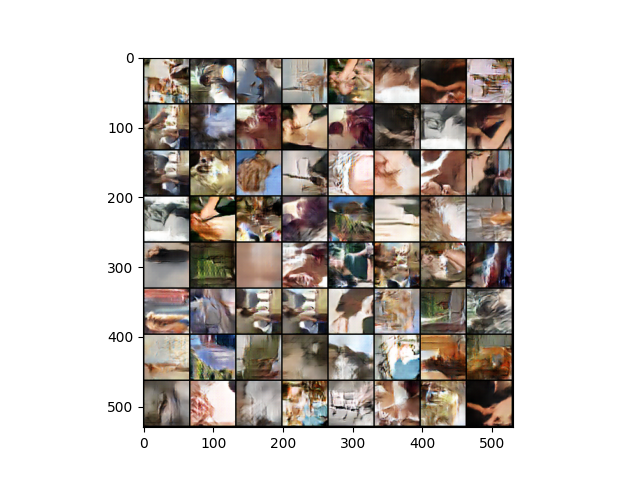


GANs, or Generative Adversarial Networks, were an early form of AI art where you had a model to cough up bogus images that fool a second model; and trained both at once. It was somewhat reliable at generating novel faces — from datasets of well-cropped faces — but strange people like me threw mixed bags of uncropped photographs, some original, some off Pinterest, and had the computer randomly crop squares. Now AI art is made by throwing keywords at something like Dreamstudio or ChatGPT, and while I have tried my hand at that, it never feels mine in an authoral sense — I didn’t pick the datasets, didn’t FAFO with the algorithm nor run it in an environment I control:



IV.
This is the Spanish Inquisition you might have come to expect by now: excepting roles that are exceptionally relational (in such a way that there’s nothing to them but exposure to the interfacticity and, in time, industry experience), I wouldn’t hire you if you didn’t know the calculus. If you really didn’t need it: I wouldn’t hire you if you didn’t understand, at the level you know in-grown nails, the difference between the first and the second set of images. But then, how would you even know what’s going in the first set? I would direct you to already linked DCGAN starter code. Is telling an executive asisstant to learn about neural networks as insane as telling data scientists to learn about fiber bundles? Not at all — you don’t really need the calculus to make AI art…
To spell (some of) it out: the second set of images is quirky; I could whip up an Adornian critique of quirky, but it wouldn’t make the main point: the thought process into coaxing some quirky out of the magic box is fundamentally different from the one involved in coaxing a pair of neural networks into playing ball. GAN art of the kind I used to make — and I hope many others went into this for a while — was essentially impossible to get right. Yes, the theory went that GAN schemes had an unique global solution where the discriminating network was fully unable to tell fake from real and the generating network had learned the probabilistic scheme (as parameterized by the multilayer convolutional model) — the “generative model” of your dataset. But in our misuse of the technology, the artist was the generative model.
See, a throw of dice can never eliminate hazard; browsing Pinterest while trying to ignore your tropes (I was deeply into Cosmopolis and Galatea 2.2) and fetishes was profoundly meditative. Not having access to the dataset, as in current AI technology, how can you purify your mind?
Of course, balancing image sets (and I don’t mean solely controlling the share of “sexy; I was looking for a mixture that made for results that were kind of readable, but unreliably so). Balacing in the current mode is propositional: even a censored model (and it’s actually harder to do this with uncensored ones), one can calibrate how prudish one wants an image to be; but it takes quite some indirection to communicate a personal view of “sexy”. More importantly: text-prompted models see “risque” (etc.) as something that, if wanted, must be predominant.
This black-and-whiteish behavior may be well a prudent statistical assumption, but it ends up leaning into McLuhan’s definition of pornography — figure without ground — whereas in my art I’d always been looking to acknowledge my “hormonal gaze” and capture its power. I’d have won as an artist if I had managed to produce a picture of a tree that, for reasons almost beyond discernment, turned up the hormonal volume of your own gaze for the rest of the day.
V.
There’s something much more general to talk about in this idea of “capturing the power” of something as ambivalently acknowledged as the “male gaze” (here used in a very narrow sense that refers to the drive to look at sexy things; “sexy”, of course, having the matching definition of “whatever catches that kind of male gaze”). This drive (and not, say, deep emotionality, which has its endogenous way of not manifesting in inappropriate settings) is perhaps the clearest example of what practical, practicing adults know as “compartmentalization”. But compartmentalization is a double-edged knife: it provides a clear framework of expectations, but produces gaps between segmented identities and “darker” (in the sense that they’re kept from several types of settings) that can become explosive. This is how we’re just emerging from the golden age of finding evidence of people’s trashy behaviors in very old Twitter posts — and twisting that, like a soaking wet towel, until it yields every last drop of political turf.
Of course, this is the kind of terrain where standard Baudrillardian rules apply; spontaneous “problematic” behavior begets the self-consciously “based” and, in turn, several layers of phonies, grifters and fakes. Not understanding (or forgetting) the Baudrillardian rules was a key mistake of “guerilla” (as opposed to later, institutionally backed forms of) purity politics: in ordinary cross-gender relations, shame can be inordinately powerful, but “shame as such”, synchronically laid out, is quickly drains any scenario of the requisite ambiguity. The correct answer when being caught with one’s pants down is “why are you in the men’s room?” The gap closes when contextualized (thus “sigma male” discourse, where timidity is recast as strategic facade). But this contextualization sucks all the air from the room.
We all want to be secure from the other’s power. The former answer was to be strait-laced and never report on making sexy AI art on a medium that’s already too easily traceable to my name and face. The new answer is to be shameless. But shamelessness is again a facade: the difference between Andrew Tate and a Jain monk is that Tate is not dressing down into his base desires (yes, to be with multiple women, have money, a posse) but building up a portfolio of the outré; meanwhile, a Jain monk is simply naked. Tate may as well be gay (which, I assume from the macho genre, would mean being a lesser dude) or something else to be ashamed of — devoutly Christian, maybe?; meanwhile, a Jain monk who gets an erection can’t hide it.
Yet: Jain monks have always had great power. Client kings during the British Raj have challenged their benefactors to protect their sacred nudity; households of all religions (I seem to remember “muslims included”, but can’t find evidence) give them alms and host them. Of course, the Jain monk’s nudity is no provocative gesture, but a radical kind of strait-lacedness. Monastic orders in all kinds of religion involve vows of poverty, but this has rarely meant a vow of transparence and the refusal of compartmentalization.
In General Axiology, Jain monks will be… oh wait.

 asemic horizon
Leave a comment