“Rhizome” is by now a default, a fact of life, pressed upon us by technological change and cultural saturation; any intensely centralized architecture is best identified by how it differs from a single-hub model, and any operational architecture has, by practical necessity, chokepoints of centralization to match our chokepoints of agency.
But decentralized models which are conceptualized via negativa are born seeded already with lines of craquelure (when not with latent fractures properly said). The “center” which we claim to “decenter” is a metaphysical presupposition on their (the “center-ists”) side that’s almost never properly established; certainly never in a way that survives “de-center-ization”. The toy visual model of graphs where germinal and terminal lines admit visual intuition and useful statistics, but eventually lets us down: the single-hub model has a presumptive center because:
- (substance ontology, graph epistemology) a single node has degree (N-1) and all others degree 1.
- (process ontology, graph epistemology) take an universe of isolated nodes; give each node a rule about how to choose a peer. the rule that says “connect to the highest-degree node” brings about the hub-and-spoke model. Probably not interestingly, but the center is selected by the third node to connect, before which Romulus and Remus stand equal.
- (substance ontology, germinal epistemology) the hub-and-spokes model corresponds to the simplest architecture where all lines are germinal. (by default in a global model there is a single germinal event; a global model being defined by the monocausality it’s able to germinate — the universe = Big Bang; evil = Luciferian rebellion, etc.)
- (process ontology, germinal epistemology) all lines known to the “graph version” are germinal and connected to a single endpoint of a terminal line connected to a disconnection model. (A global model is, at least heuristically, dual to a disconnection model; the latter tells us which thread to pull so everything falls apart)
- (substance ontology, terminal epistemology) the child nodes are all converging terminal lines to a single pluripotential node. Absent a definite time-order from germinal to terminal, pluripotentiality can either be a feature of the egg or of God — the One that can animate (give soul to) the Many possibilities; or the mark of the hyperdeterministic End of History.
- (process ontology, terminal epistemology) barred from connecting to the endpoint (say, due to capacity constraints), new nodes’ best strategy to joining the terminal line is connecting to the Initial Children’s germinal pole, producing a germinal circle. (This is perhaps the simplest model in which we’re able to ditch the analogies with graph theory.)
It’s substantially more difficult to think of these reduction procedures in the general case:
- (substance / graph): a model as simple as a cycle (a benzene hexagon!) no longer has a single “topological ordering”. there is more than one calculation method that produce “centrality scores”, each with slightly different underlying maths.
- (process / graph): the center of a graph is defined by a mode of occupation: ants running at random will saturate it according to its eigensystem; infinite explorers armed with the ability to cross from A to B by the shortest route will saturate nodes by their “betweenness”.
- (substance / germinal): germinal reduction is obtained by procedures of determination (loss of terminality). the thresholds of determination may correspond to features of the world: wetness ≃ first drops of rain). Here, an open question remains: multiple, independent ways of determinating a system could either form a spectrum of determinating thresholds (explanatory superposition) or correspond to overlapping monocausalities (global model superposition).
- (process / germinal): germinal reduction is feature loss: in central systems we considered the loss of single-componentness (first homology), but we may instead mourn the loss of closed cycles (second homology) and so on. The homology series here is an ad-hoc choice that (besides giving us hubs and benzene rings) neatly arranges in a sequence and decides the multiple determination problem in favor of a threshold spectrum. (In other words, what we’ve described here is “homological germinal reduction”)
- (substance / terminal): The general issue for terminal reduction is whether the system has “plural pluripotentialities”. in a graph analogy, the question would be whether the system has multiple “local hubs” (and local hubs of local hubs…). but the graph construction can’t account for collisions as pluripotentialities expand.
- (process / terminal): A concept of pluricentrality may come from time-order if the world’s history can be rolled back (or forward) until germinal circles appear. The procedure pushes this idea until either (1) only germinal circles remain — true pluricentrality or (2) no remaining structures can be rolled back into circles. Pluripotentiality is then given by a spectrum of “de-germinating thresholds”
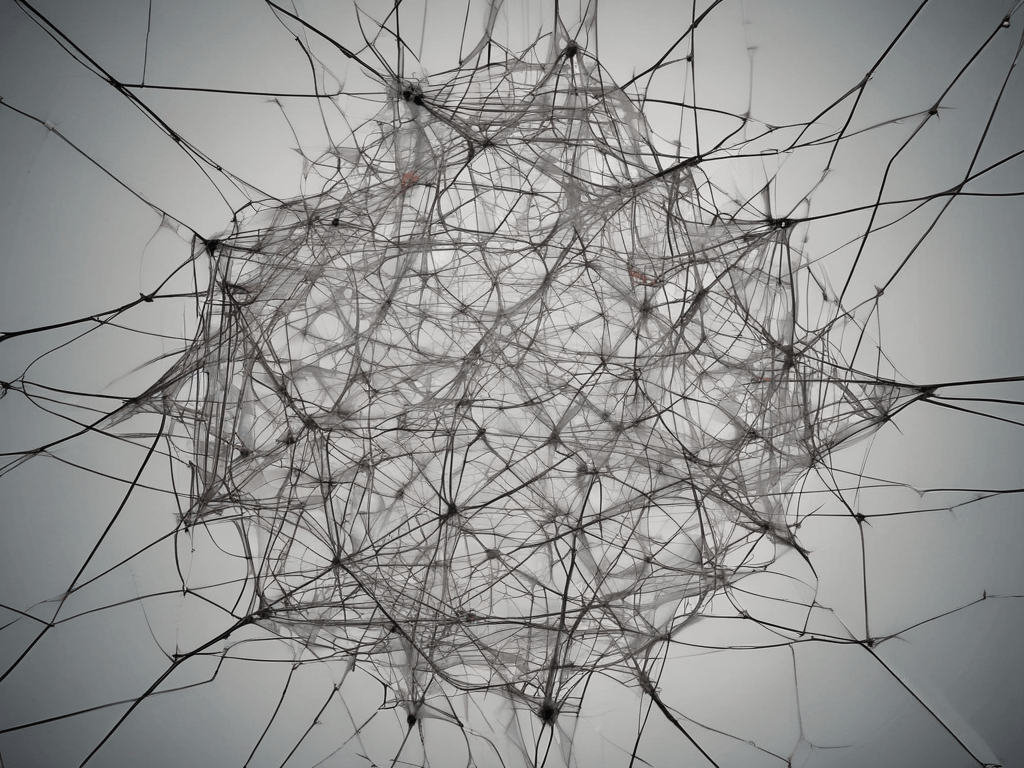
 asemic horizon
Leave a comment