Definite terminality in its quality as definite terminality comes close enough to the process-philosophical notion of singularity that I can’t actually tell them apart (at least at this moment in theory development). Terminality is the process by which differentiation is arrested; definite terminality is the attribute of not being able to further differentiate.
Classic neurology understands neurons to be definitely terminated — that is, fixed and impermeable to forces that might otherwise press for change. To the extent that the standard consensus on scientific reduction avails what theory needs it to, definite terminality of neurons is tantamount to individual singularity — individual personality, if we’re thinking of humans. The process of a particular person’s life is then conditioned by modulating the self-anihilating tendency of all cells: to arrest death long enough that personality has the time and space to ex-press something, to press something out of themselves. These outpourings are de-terminations: they’re popped out of the dying biological thing and become separately differentiable, reproducible, remixable, misinterpretable.
This neurocentric view of the person is, of course, a raft that one uses to cross a river and then discards. It serves us to ilustrate terminality as a kind of death-within of all processes.
We often would like to have answers to questions, terminal answers, de-finite in that they escape the finitude of provisional episteme and become infinite in their reach. But even the Abrahamic God can only terminate capital t-Truth in a kind of last instance. To the extent his Creation is marked by definite terminality, it is the only possible creation; this meshes uneasily with omnipotence, or rather, requires God to have a further layer of powers, a metaomnipotence — the power to be omnipotent in any way He desires it, the power to arbitrarily terminate the world. But then — standard Abrahamic doctrine is that there is a particular determinate (however self-imposed at the meta layer) form of omnipotence that gives sharp upper bounds on God’s ability to intervene in the universe. All human termination then happens in history (Darwinian morphogenesis and human self-axiomatization). And I think most people who have thought things through are bathed in the feeling that this terminality is arbitrary; some even arrive at the conclusion that ultimate determination, indefinite determination, is reachable from within the germinal-terminal circuitry we flow in. To someone like Aubrey de Grey, this means immortality of the flesh; to asemic horizon circa 2019-21, this meant general axiology.
But does “indefinite determination” even mean anything? Is it somehow commutable or otherwise related to the more palatable “definite indetermination”? “Definition”, after all, stands for a particular kind of “infinity” that obtains from expressing something abstract in something material — like one squeezes out the oil out of olives. The hope that the abstract derives from the material is, of course, modern Humean empiricism — and therefore not such a hard sell. And we all know what “indeterminate” means: it’s a swarm of possible determinations, i.e. a germinal circle. “Indetermination” is then exactly what the tin label says: “germinal reduction is obtained by procedures of determination” and therefore indeterminability is germinal irreducibility. “Indefinition” might therefore stand for an analogous “swarm”, a mass of suspended particles — each one the infinite scope of a definite abstraction. If (and this is a sizeable “if”) this flimsy attempt avails, then “indefinite determination” can be derived as a sort of blend of conceptions of germinal circles — a germination over germinal irreducibles.
This becomes a tall order for Aubrey de Grey types: it immortality for arbitrary humans with almost no sense of their history — certainly not genetic testing for telomere length or whatever is current in gerontology. Immortality science (indefinite determination) involves, in this way, what asemic horizon used to call a “switcheroo” over gerontology (definite indetermination). The problem for asemic horizon was that we posited our indefinites — genericity, I called them, a single voice raising their clamor — and subsequently forgot they were pretty much revealed in a fever dream. Theory was the theory (of the theory of the theory…) of generic structure; but generic structure would be a determination over indefinitions (determinate indefinition).
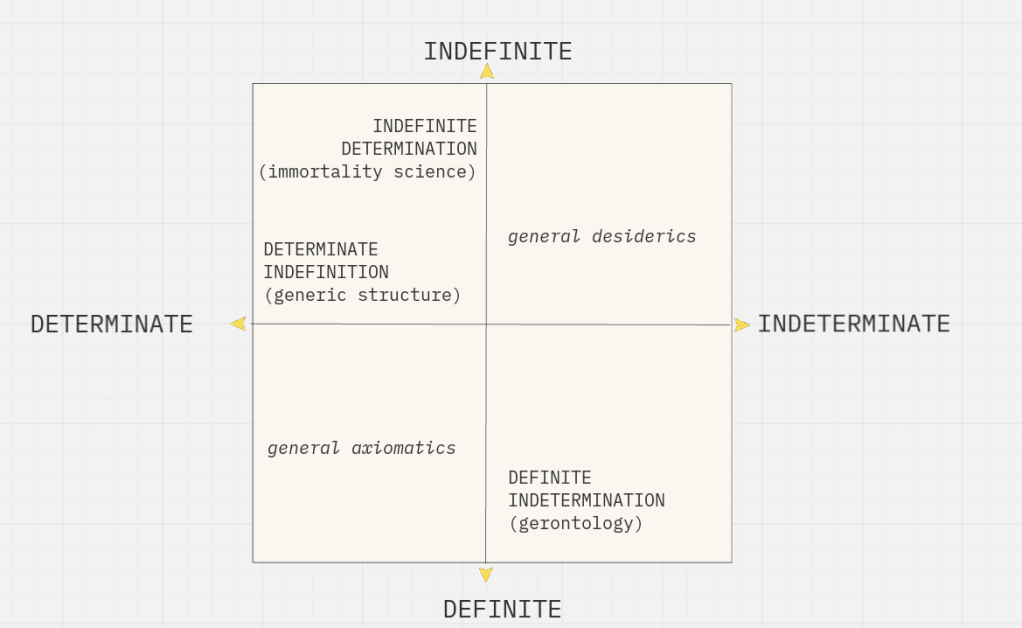
So what is terminal acceleration (not to be confused with germinal acceleration)? It’s that towards-death vector between the empty quadrants that takes us to the arbitrary satisfaction of immediate desire, that mirror symmetry of Buddhist dharma that says “infinite bliss here, now”. Terminal acceleration explains modernity.

 asemic horizon
Leave a comment