I.
You know Claude Code is good because suddenly everyone seems annoyed by its restrictions. By contrast, there is only praise for similarly-aimed tools like Cursor and Wind…whatever it’s called; this means they’re either not used for serious projects or by serious people.
II.
As a child — in the 80s — I was told by an actual software developer that computers could only be made useful if given very detailed, sequential instructions. Computer people subsequently came up with successor “paradigms” (object-oriented, actor-model, etc); but these are as effective at dissolving the sequential nature of computers as numerically-controlled lathes are at dissolving the woody nature of wood. There was an alien invasion into computers that did provide programmers with novel affordances: the introduction of “type inference”, brought straight from the distant stars of logic and higher mathematics. That futurity, however, was unevenly distributed; it enabled vibe-reasoning about data structures, but not, like, vibe coding.
III.
What is it with children and trains? They’ve never actually seen locomotives of the choo-choo variety with its rich internal rhythms, yet they love toy trains more than they like toy helicopters or toy snowmobiles. Of course, steam power was in its day more impressive than Claude Code (which is still, to keep analogies, closer to Mazeppa’s horse than it is to true vibe-travel). In many ways — possibly every way — to live after the emergence of steam-powered travel is to know the other side of a kurzweilian singularity. I’m not sure if this is how toddlers understand it, but toy trains stand for everything technological that comes to them as birthright — running water, buckets of marbles, bluetooth. Does this mean there’s a cargo cult to choo-choo trains that we keep passing on? Well, yes.
IV.
A child aged 3 or 4 can be made to understand that there’s a single thing called “electricity” (we tend to call it “light” — with kids, you can’t be a stickler for accuracy all the time) that powers the refrigerator, the TV and the lights themselves in their light sockets. It’s considerably more difficult to similarly explain the internet: they’re very aware that, while we can’t watch Netflix on the TV when the “light” goes out, Netflix is still in existence in our battery-powered phones. This is probably even more true if you make the informed parental decision not to give them their own devices yet: as far as they’re concerned, their music just exists anywhere they want. They’re just vibing.
V.
Remember Accelerando, by Charlie (or just “Charles”? I own a physical copy, but my library is in terminal disrepair, now admitting only random search) Stross? At one point in asemic horizon‘s arc I kept pointing to Crystal Castles as my paradigmatic marker of peak history; Macx and agalmics, however more typical, had by then faded from my theoretical field of view. Accelerando was… really, a novel of femdom erotica set against a continually fragmenting postsingularitarian background. This is not shade thrown at Stross; the sex stuff (which is not restricted to the action-packed theatrics of the first chapter, as many believe, but even reaches the next generation) undermines both Macx’s basic Hiro Protagonist-ness and the faux-radical politics of agalmics. Stross is now half-dismissive of Accelerando (a “journeyman novel”), which reads like a half-blessing to go ahead with death-of-the-authoring work that might shed much needed clarity on what the hell was, more generically, that peak-00s earnestness and whether the hell it survives anywhere.
VI.
Dylan Moran had a beautiful joke (probably easy to find on YouTube) about being both compulsive and indecisive — the man needed to do something right now, but what? That open demand is, of course, a hallmark of both Manfred Macx’s politics and his kink (“you still haven’t told me what to do”). At least at face value, this strongly contrasts to sacher-masochism proper as described by Deleuze in Coldness and Cruelty, which pivots around the slavery contract and the ensuing distance and silence. At the same time, it also stands in stark contrast with Socratic irritation; Socrates needs the Many (who, unlike him, know something) like Macx needs billionaires to exploit him for free, invaluable advice — but Macx just stands there waiting. These are unsettling comparisons; what do they mean for that one Gilles Grelet poem that “one-shotted me” into launching asemic horizon? Of course, Grelet himself seems to have found a better finale than either: unlike Macx and Sacher-Masoch, infinitely receptive, or Macx and Socrates, endlessly seeking engagement, Grelet just moves to a boat.
VII.
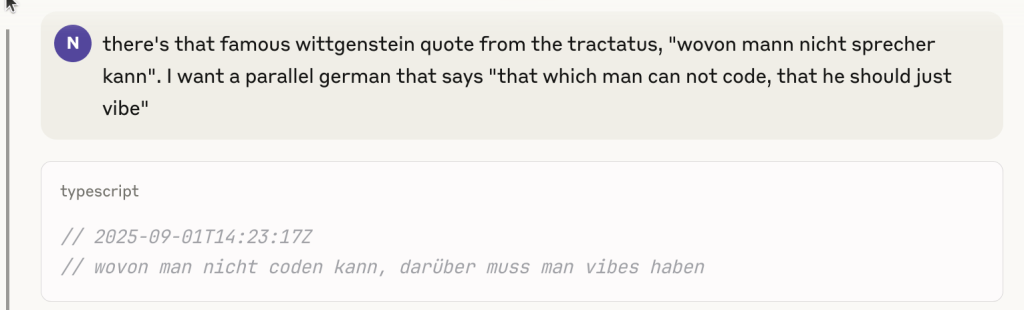
Greek philosophy famously culminates (after failed formulae like “featherless biped”) on a definition of Man as the “city-dwelling animal”. Yes, this is amusingly parochial; it’s only by the end of the 2000s that the share of humans living in urban areas (of some sort) becomes majoritarian. Mainstream commentary tends to explain that the phrase means only in cities the telos of man can be fully realized. Grelet’s presumably permanent retreat from the city can, then, be restated as a retreat into atelicity and a radical existential statement of the difference between philosophy and theory. In less ennobling words, of course, it’s also a move towards plain vibing. Yes, le chiendent est aussi du rhizome — in a different life, Gilles Grelet would likely be vibe coding. What a fierce, purposeful world would that be, on the strength of him alone hammering at Claude Code, prompting for untestable, atelic, open-ended programs.
VIII.
 asemic horizon
Leave a comment